
When a Perc Test Becomes Necessary for Rural Landowners
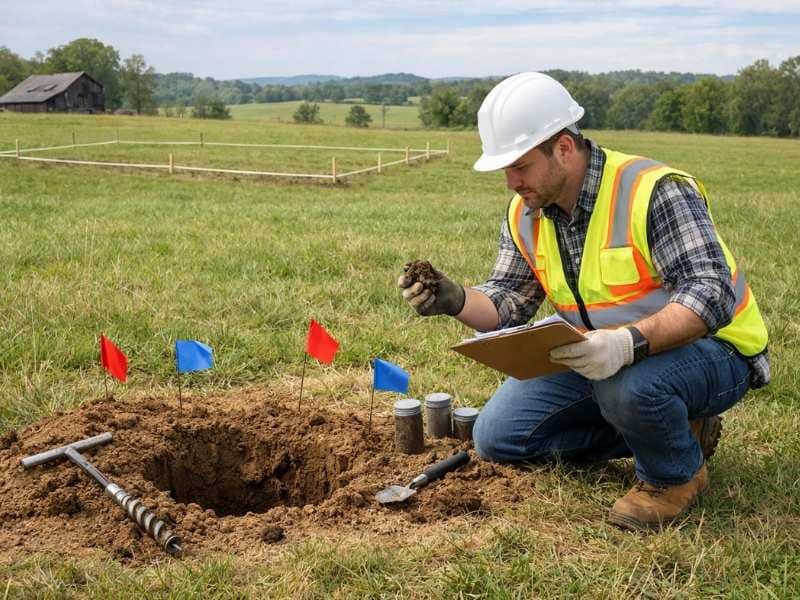
If you’re buying or building on rural land near Bowling Green, Kentucky, and the property doesn’t connect to a public sewer, you’ll need a perc test before you can move forward with construction. It’s not optional. In Kentucky, a perc test is required by law before a septic permit can be issued. For rural landowners, understanding when a perc test is required and what the results mean can be the difference between a buildable lot and a costly mistake.
What a Perc Test Actually Measures
A perc test, short for percolation test, measures how quickly water moves through soil. During the test, a professional digs one or more holes in the area where a septic drain field would go, fills them with water, and tracks how fast the water absorbs into the ground. That rate is called the percolation rate.
The result tells health officials whether the soil can handle wastewater from a septic system safely. If water moves through too slowly, it pools on the surface and creates a health hazard. If it moves through too fast, the soil doesn’t filter contaminants before they reach groundwater. Either outcome can mean the site won’t pass.
Soil type has a big effect on results. Sandy and gravelly soils tend to drain well. Clay-heavy soils absorb water slowly and often struggle. Rocky ground with shallow topsoil can fail for similar reasons.
When Kentucky Law Requires a Perc Test
In Kentucky, a perc test is required any time a property needs a new on-site sewage system. This applies in the following situations:
- Buying rural land to build on. If there’s no public sewer connection available, you need a passed perc test before you can get a septic permit, and you can’t get a building permit without one.
- Adding a structure that increases wastewater load. Building a guest house, converting a barn into a living space, or adding bedrooms can trigger a new or updated evaluation.
- Replacing or installing a new septic system. Even on an existing property, a new system requires approval from the local health department, which includes soil evaluation.
- Subdividing land. If you’re splitting a parcel into separate lots, each lot intended for development must be evaluated individually.
The local health department in Warren County handles septic permits and site evaluations. They conduct or oversee the test, review the results, and determine whether the site qualifies for a conventional system or requires an alternative design.
What Happens If the Land Fails
A failed perc test doesn’t automatically mean the land is unbuildable. It means a standard gravity-fed septic system won’t work at that location, or in that part of the property. You have several paths forward.
Test a different area of the property. If the initial test was conducted in one spot, another area on the same parcel may have better soil conditions. Soil composition can vary significantly across a single lot, especially on rural acreage with mixed terrain.
Wait for better seasonal conditions. Soil drainage changes with rainfall and water table levels. Testing during a wet period can produce worse results than testing during dry months. Some landowners retest in summer when soil conditions improve.
Consider an alternative septic system. If the standard system isn’t viable anywhere on the property, alternative systems designed for poor soil conditions may still allow construction. A mound system raises the drain field above ground level to create more distance between wastewater and the restrictive soil layer below. An aerobic treatment unit, sometimes called an ATU, uses oxygen to accelerate wastewater treatment and works on smaller lots or sites with limited suitable soil. These systems cost more to install and maintain than a conventional septic setup, but they can make otherwise unusable land buildable.
Consult a licensed soil scientist or septic designer. If you’re unsure what your options are after a failed test, a professional who specializes in on-site wastewater systems can evaluate the site and recommend a design that meets state requirements.
In Kentucky, only the local health department can officially approve a septic system. A private soil professional can advise you, but approval authority rests with the health department.
Perc Test Timing: Get It Done Before You Close
The most common and costly mistake rural land buyers make is skipping the perc test during due diligence. If you purchase land without testing and it fails, you may own property that can’t legally support a home.
Make any offer to purchase rural land contingent on the property passing a perc test. That clause gives you the ability to walk away or renegotiate if the soil doesn’t meet requirements. Once you close without that contingency, the problem is yours to solve at your own expense.
A perc test typically costs between $300 and $900 for a basic test, with more complex evaluations running higher depending on the number of holes required, the depth of testing, and the health department’s involvement. That’s a small cost compared to buying land you later can’t develop.
How the Process Works in Warren County
In Warren County, septic system approval runs through the local health department. The general process looks like this:
- A certified professional or health department environmentalist performs the site evaluation and perc test.
- The results are reviewed against Kentucky’s soil and drainage requirements.
- If the site passes, you receive approval to proceed with septic system design and permitting.
- A licensed installer constructs the approved system.
- The health department inspects the finished installation before the system goes into use.
The evaluation determines not just whether a septic system is allowed, but what type, what size, and where on the property it can be placed. That information also affects where you can site a home, a driveway, and other structures, since there are required setback distances between a septic system and any building, well, or water source.
